 |
Modular and Reconfigurable The key to success incustom solutions. |

AIR-COUPLED ULTRASOUND
The revolution in non-contact ultrasound systems, from a single channel to hundreds of channels.


|
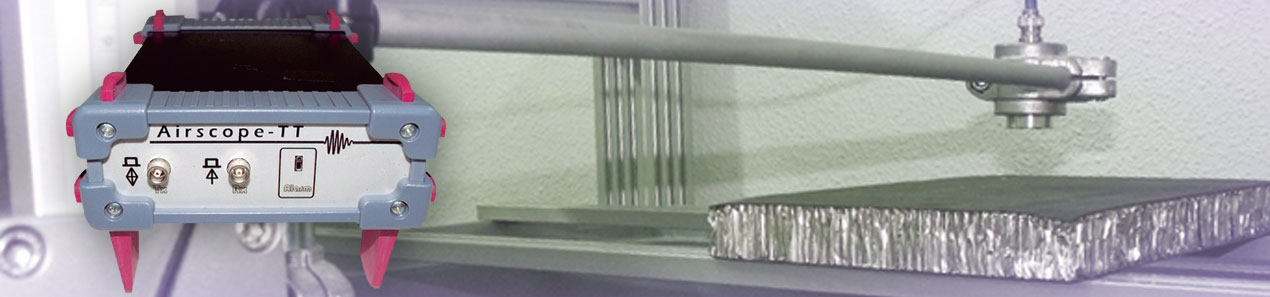
Modular and Reconfigurable The key to success incustom solutions. |
 |
Training Personalized training courses. |
 |
ENGINEERING Feasibility study as a key of sucess. |
 |
ULTRASCOPE SERIE ULTRASCOPE USB,all the power of a high-end system in the palm of your hand. |
 |
DIFRASCOPE Much more than a multi-channel TOFD sustem. |
 |
AMPLUS-32 AMPLUS-32 is a broadband pre-amplifier fully compatible with ULTRASCOPE / DIFRASCOPE. |
 |
PHASED ARRAY SYSTEM Phased array systems,based on the SITAU technology. |
 |
GNR FILTER See beyond structural noise no matter grain noise present on the material. |
 |
AUTOFOCUS Get the best image quality with a single click... no matter how complex the geometry is. |
 |
FULL PARALLEL PHASED ARRAY Synthetic Aperture Techniques (SAFT), Full matrix capture (FMC), total focusing method (TFM), Sampled Phased array, can be implemented. |
 |
GPU Development Kit Complete your SITAU Phased-Array system with the power of GPU’s. |
 |
AIRSCOPE SOLUTIONS Air-coupled NDT solutions for compiste inspections. |
 |
AIRSCOPE MULTICHANNEL Air-coupled NDT solutions for compiste inspections. |
 |
AIRSCOPE PHASED ARRAY Unique in the world ,Non coupling Phased Array system. |
 |
Air-Coupled transducers Wideband transducers from 25Khz to 2 Mhz. Focus and Non-focus. |
 |
Ultrasound Scanners Fully compatible with ULTRASCOPE, DIFRASCOPE and SITAU products. |
 |
Inmersion Tank Wide range of immersion tanks for non-destructive testing in water bath. |
 |
Ultraview,Ultrascan & TOFD view Powerful software tools to easily cofigure the system parameters. |
 |
MotorMotion MotorMOTION is a fully programmable steppermotor control unit, capable of simultaneously controlling up to 3 axes, with configurable acceleration ramp and micro-steps. |
 |
Ultrasound- CALC, Phased Array-Wizard and TOFD-CALC A series of handheld tools for NDT, based on Android Operating System. |
 DASEL is a company specialized in the development of high-end ultrasound technology. We offer at the same time flexible solutions according to each client requirements. Therefore the quality level in our products has not been neglected. Quality is a commitment that DASEL applies in all production areas to maintain traceability of manufactured products. For this reason the company has been certified ISO 9001:2015 and ISO 9100:2018 by Bureau Veritas in the equipments production and calibration.
 DASEL develops all its products with a modular architecture and using high-density re-configurable devices (FPGAs). Given the high cost for new hardware development, this design philosophy allows to adjust our systems to many different applications, with the incorporation of new functions or specific algorithms with no need to upgrade the equipment electronics.
 |
 |
 |
 |
||
| ISO 9001:2015 | ISO 9100:2018 | ||||
|
PYME INNOVADORA
Válido hasta el 22 de febrero de 2022
 |

The project ULTRACOV aimed at developing a novel ultrasound scanner to face COVID-19 disease challenges: early diagnosis and following of patients evolution leaded by DASEL get funded by last CDTI call.
This project obtained funding from the las call of the Spanish Institution “CDTI” (July 2020) in a very competitive call for R&D projects to face the health emergency COVID19. ULTRACOV This development is led by DASEL SL, a Madrid SME based in Arganda del Rey. The Ultrasonic Systems and Technologies Group of the CSIC (GSTU-CSIC) and the Nuclear Physics Group Group of the Complutense University of Madrid (GFN-UCM) will also participate. The participation of the emergency ultrasound service of the Hospital Universitario La Paz guarantees the clinical approach at all stages of the development of the ultrasound system, and will carry out the first trials with patients.
The project duration is 18 months, (starting July 2020) and clinical trials of the prototype are planned to begin in early 2021.
The objective of the ULTRACOV project is the development of an ultrasound scanner oriented to the early detection and monitoring of the COVID-19 disease, specially designed for situations of pandemic and high healthcare pressure. Through interactive artificial intelligence tools that simplify the examination and interpretation of images, and a design oriented to operation in high-risk conditions (easy disinfection, ergonomics, etc.), the aim is to extend lung ultrasound to a greater number of professionals and services, from primary care to intensive care. The impact on the capacity of the healthcare system for the management of COVID-19 patients would be very positive, since it is a very specific tool for evaluating the lung condition at all stages of the disease, including potential chronic problems. in the medium and long term. Furthermore, it would be useful for the diagnosis and management of patients with other lung pathologies, potentially serious in certain groups (pediatric patients, pregnant patients, etc.).
Sector : Eolic Energy
Material : Glass-Fiber Composite
Technology : Phased Array
Equipment : SITAU-311-PRT
Keywords : Phased Array, GFRP, Aerogeneradores
Title : Detection of broken fiberglass in wind turbine blades
1. Introduction
Non destructive evaluation of windmill blades using ultrasound is a challenging task. Microstructure of fiberglass and resin composites (GFRP) introduces dispersive effects on ultrasound waves, which is seen as grain noise and produces high attenuation to ultrasonic signals. The traditional approach to overcome these problems is using low frequency transducers (typically 500 kHz), at the expense of loosing resolution, and hence, the capability to detect small defects or to inspect low thickness components.
In this work, results of the inspection of a thin GFRP layer (3mm) using phased-array technique are presented. The goal is to detect the presence of broken fibers in the material. A 5MHz array was used, along with a novel C-Scan processing technique, that allows to detect broken fibers with a resolution above 1 mm.
2. Materials and Methods
A phased array with 128 elements, inter-element pitch of 0.5mm and 5 MHz was used, in contact with the flat surface of the inspected part (see Figure 1). A SITAU-311-PRT equipment was used, with 32 channels multiplexed to 128 array elements, and linear B-Scans at 0º were performed.

Figure 1 – Inspection scheme
3. Results
The inspection goal is to detect broken fibers in a 3mm thickness layer of GFRP material. Shown images were obtained in field, from a real windmill blade, with a 500mm length cut in the inner glass-fiber layers.
Figure 2 (right) shows three of the B-Scans acquired along the fiber cut. As the ultrasonic pulse is not able to individually resolve each one of the glass fibers, what is seen in the images is an interference pattern between the echoes received by all fibers in the fabric. Relative position between fibers changes in the damaged zone, and so that, interference pattern also changes.
Presence of broken fibers does not necessary mean that received amplitude will decrease, because glass-fiber layers can become overlapped in the curing process. In that case, fiber damage cannot be detected by means of conventional amplitude C-Scan ( figure 2 left ).
DASEL has developed a novel processing algorithm (GFRP-Scan®), based on the interference pattern analysis, that is capable to detect broken fibers also at very low thickness layers ( figure 2 center ). As signal processing is based on global information contained at each B-Scan, it is little sensitive to configuration parameters, and hence, a very robust evaluation method.

Figure 2 – Images from a windmill blade with a 500mm length cut in the inner GFRP fibers. (Left) Conventional C-Scan (Center) GFRP-Scan®
(Rigth) Several B-Scans at different positions.
4. Conclusions
Beam focusing capability of phased array systems allows using higher frequencies when inspecting GFRP components and so that, a much higher resolution can be achieved compared to traditional low frequency transducers. In this work, the feasibility of detecting broken glass fibers in a 3mm thickness GFRP layer was demonstrated.
GFRP-Scan® algorithm, included in the ScanView® software and available for all SITAU models, allows detecting small defects in fiberglass layers with high reliability. Its effectiveness has been proved by the inspection (in field) of more than 50 blades before being installed in a wind farm.
5. References
4. Links to equipment used
- SITAU-311-PRT
Industrial Scanners
Aerospace Inspection Solutions
Flaw Detectors
Ultrasonic Flaw Detectors
Phased Array
Guided Wave
Pulser-Receivers
Integrated Inspection Systems
Bar Inspection Systems
Tube Inspection Systems
NDT Systems Instrumentation
Advanced NDT applications
GLASSFIBER BROKEN FIBERS
GLASSFIBER UNBOND
RAILWAY STEEL BOLTS
CASTING INCLUSIONS
AUTOMOTIVE NODULARITY
Applications
Application Notes
Applications Support
PDF Library
Video Gallery
Software Downloads
Training Academy
Obsolete Products
ISO Certifications